Olive skin can wear a wide range of colors, which is useful until a supposedly flattering top makes the complexion look grey, yellow, or oddly flat. The problem is not that olive skin is difficult; it is that the same surface tone can sit over warm, cool, or nearly neutral undertones. Good clothing colors for olive skin tone come from noticing the direction of your own coloring and then testing how a fabric behaves near your face.
Why olive skin is easy to misread in a shop
Olive usually refers to a green-grey cast in the skin, not a single depth or ethnicity. It can appear on light, medium, or deep complexions and may change a lot between winter and summer. Under store lighting, that subtle cast is easily hidden by warm spotlights and mirrors. A beige sweater may look polished under a fitting-room lamp, then turn muddy outside. That is why a label such as warm, cool, or neutral is a starting clue rather than a rule you have to defend.
Begin with clothes you already know. Put a pure white shirt, a cream knit, a charcoal tee, and a warm camel layer near your face in daylight. Notice which ones make the skin look even and which ones make dark circles or a yellowish cast more visible. This is more useful than checking veins or trying to decide whether a celebrity has the same coloring. You are looking for a repeatable visual effect in your own mirror, with your own hair color and usual level of makeup.
Find the warm, cool, or neutral direction
Warm olive skin often looks especially at home beside softened earthy colors: olive green, rust, warm navy, cream, tobacco, and deep turquoise. The key word is softened. Bright mustard or a flat yellow-beige can pull out too much yellow, while a darker, slightly muted ochre may look rich. Gold jewelry often sits easily with this direction, but do not use jewelry as the only evidence; a warm olive complexion can still look better in a cool white shirt than in a yellow cream.
Cool olive skin tends to respond well to blue-based color: ink navy, blue-red, emerald, plum, charcoal, and cool taupe. If coral lipstick or orange-red knitwear always seems to sit on top of your face rather than belong to it, that is a useful signal. Neutral olive can borrow from both groups, but benefits from choosing one temperature at a time. A neutral olive person may look great in cream and teal, yet less convincing in a cream top with a very icy lilac scarf because the two directions compete close to the face.
Choose neutrals that look deliberate
Many people with olive skin are told that any neutral will work. In practice, the undertone of the neutral matters more than its name. Cream is often kinder than bright white for warm or neutral olive, while soft white can be excellent for cool olive. Stone, mushroom, chocolate, ink, charcoal, and dark denim are usually easier than a pale putty beige. They create enough definition without asking the complexion to supply all the contrast.
Black is useful but can make an olive complexion look sallow when it is the only color near the face. Try an open-neck black top with gold or silver earrings, a patterned scarf, or a jacket in deep teal instead of a closed black turtleneck. Navy is the most forgiving substitute because it reads as dark and practical but has more life than black. For trousers and coats, black remains simple; use the color closer to the face to do the flattering work.
Pick accent colors for real outfits
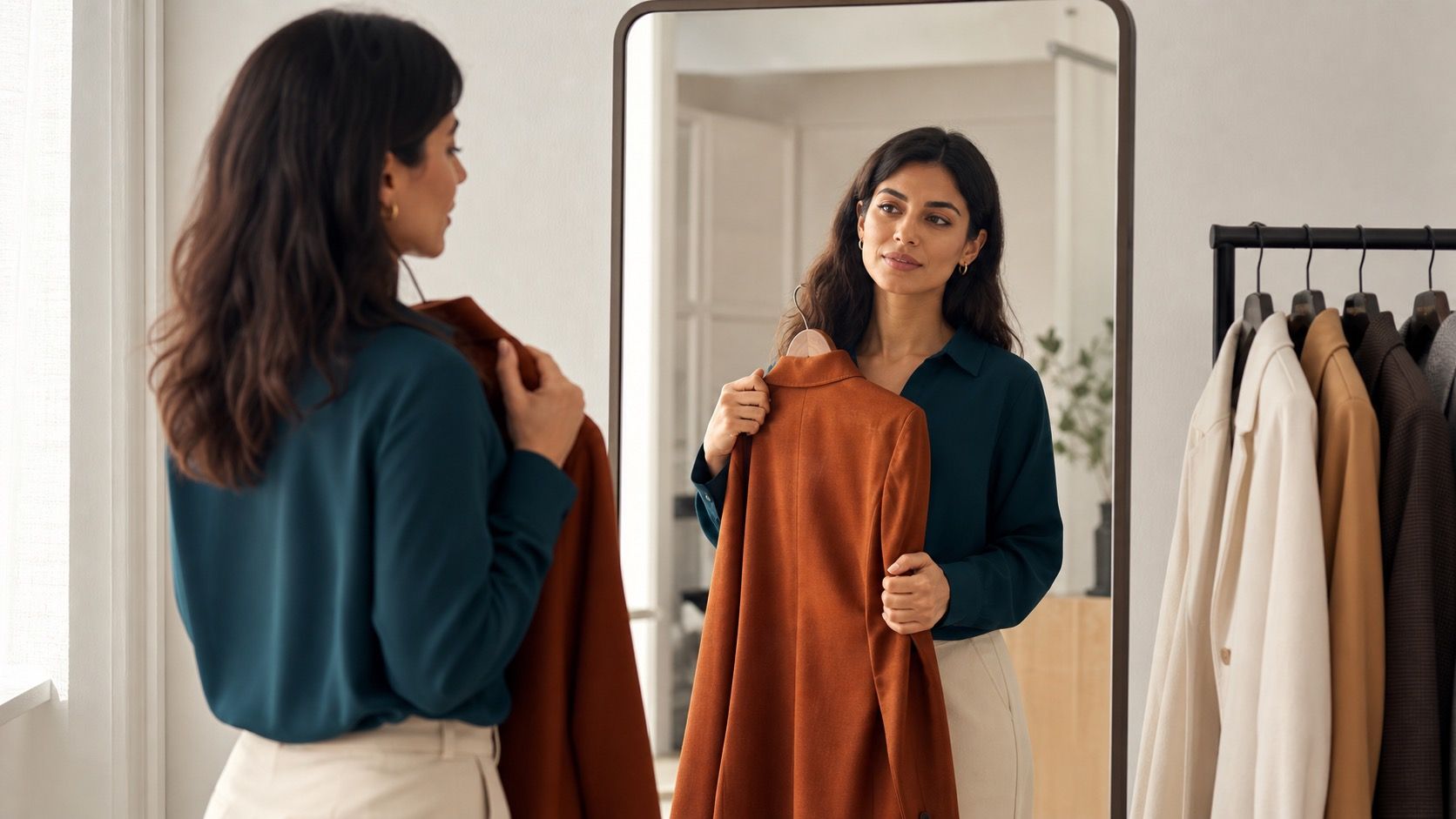
Teal is one of the best colors for olive skin because it bridges green and blue without going too bright. A dark teal blouse, a blue-green overshirt, or a teal dress can make the skin look clearer while still feeling easy to wear. Deep emerald, petrol, aubergine, brick red, and muted raspberry are similarly useful. They have enough depth to stand beside the natural green-grey cast in the skin, so they tend to look intentional even with simple jeans or cream trousers.
Red needs a small amount of trial and error. Warm olive often suits tomato, rust, and paprika reds; cool olive often prefers cranberry, wine, and cherry. A bright true red can work on both, but the fabric finish matters. A matte cotton tee is more forgiving than glossy satin because it reflects less color back onto the face. If a red dress feels too strong, move the color away from the face with red trousers, shoes, or a bag and use a calmer cream, navy, or charcoal top.
| What you are testing | Try first | Watch for |
|---|---|---|
| Warm olive direction | Cream, rust, warm navy, dark turquoise | Very yellow beige making skin look sallow |
| Cool olive direction | Ink, emerald, plum, blue-red | Orange tones looking separate from the face |
| Neutral olive direction | Stone, teal, muted berry, soft white | Mixing icy and very earthy shades at the neckline |
| Everyday neutral | Dark denim, charcoal, mushroom, chocolate | Pale beige erasing natural contrast |
Handle white, green, and red with more precision
White shirts are worth testing because they reveal undertone quickly. Optical white can look crisp and modern on cool olive skin, while warm olive skin may prefer ivory, ecru, or a soft off-white. If white is required for work, the shape gives you options: an open collar, a V-neck, or an overshirt with a dark layer underneath reduces the large block of white beside the face. Fabric also helps. Textured cotton or linen looks softer than a bright, smooth synthetic shirt.
Green is not automatically perfect simply because olive skin contains a green cast. Neon lime and yellow olive can blend into the complexion, while forest green, jade, emerald, and blue-toned teal usually provide useful separation. The same idea applies to red: find the red that adds clarity rather than flush. Compare two shades in a window and take one unfiltered phone photo of each. The winning color will usually make the lips and eyes look more defined before it makes the garment look dramatic.
Build a small reliable palette before buying more
Rather than collecting every shade called flattering, choose three base neutrals, two dark colors, and three accents you can combine. A warm-leaning palette might be cream, dark denim, tobacco, warm navy, teal, rust, and muted coral. A cool-leaning palette could use soft white, charcoal, ink, emerald, plum, berry, and blue-red. Neutral olive can often mix stone, navy, chocolate, dark teal, muted rose, and one richer green. This gives you many outfits without a closet full of isolated statement pieces.
Keep a short note of the shades that earn compliments on normal days, not only in a flattering changing-room mirror. Recheck after a haircut, a seasonal change in skin depth, or a new hair color, because contrast can shift. The best colors for olive skin are not a fixed personality type. They are the colors that leave your face looking awake and balanced while the clothes still feel like something you would actually choose to wear.