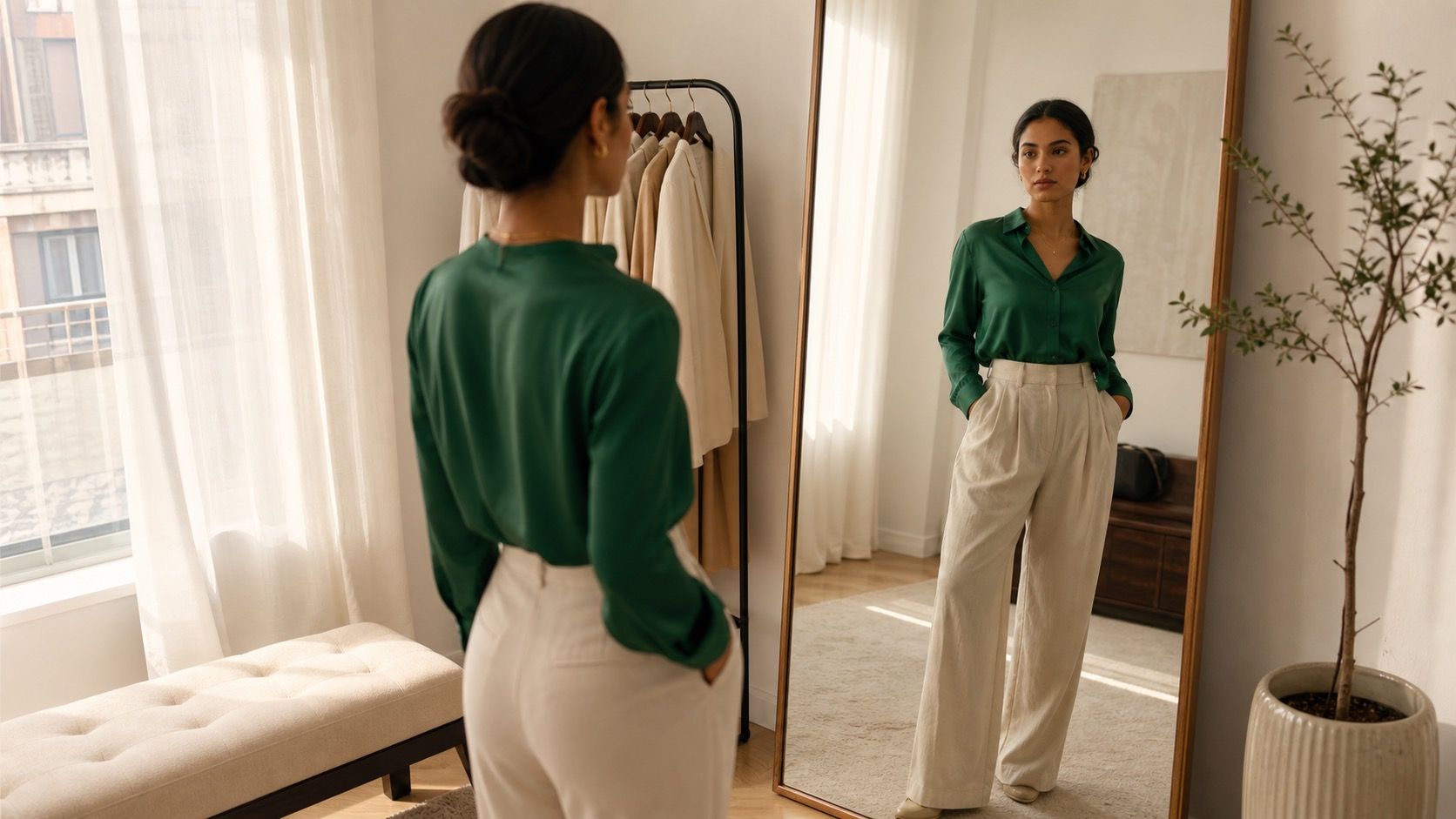
Deep Winter outfit colors can look wonderfully decisive, but they can also become a wall of black very quickly. The practical challenge is to keep the depth and clarity that make these shades satisfying while still looking like a person on the way to work, dinner, or a rainy Saturday, rather than someone dressed for a dramatic studio portrait.
Use contrast as a dial, not a uniform
Deep Winter tends to handle a stronger difference between light and dark than muted palettes do. Think black with icy white, deep teal with cool gray, or a dark berry knit over a pale blue shirt. Yet high contrast is an option, not a daily requirement. If your wardrobe uses only black and white, the effect can become severe by lunchtime. On a tired day, navy with charcoal or aubergine with black gives depth with less visual noise.
Try the mirror test with a plain white sheet of paper near your face. If a dark, clear color makes your features look more defined rather than hollow, it may be a good direction. Then test it in the garment you would really wear: a soft black crewneck behaves differently from a stiff black blazer. Fabric, shine, and neckline can add as much contrast as pigment. This is why a color chart alone rarely settles the question.
Build dark neutrals that do more than black
Black is useful for Deep Winter, especially for boots, trousers, coats, and a sharp column outfit. It is not the only foundation. Deep navy makes bright fuchsia or icy pink look intentional instead of random. Espresso that reads cool, blue-black denim, charcoal, aubergine, and deep pine green give the same visual weight while changing the mood. A navy suit is usually easier at a daytime meeting than an all-black suit, even when both technically suit you.
Look at dark neutrals in natural light before committing to a coat or bag. Some so-called navy is nearly warm purple; some charcoal is brownish enough to muddy a cool pink blouse. The difference is small on a hanger and obvious beside your face. For a capsule, choose two dark anchors. Black plus navy is the simplest pair. Add one alternative, such as deep teal trousers or an aubergine cardigan, so every winter outfit does not use the same silhouette and mood.
| Situation | Color combination | Why it works |
|---|---|---|
| Office presentation | Ink navy, icy blue, silver | Clear enough to look composed without relying on black |
| Casual weekend | Blue-black denim, deep teal, cool white | Dark base with a fresh point near the face |
| Evening dinner | Black, deep berry, pewter | Depth stays present while berry breaks the black column |
| Cold-weather layer | Charcoal, pine, icy gray | Low shine and cool contrast work well in knitwear |
Put clear accent colors where they can be seen
The clear part of a Deep Winter color palette is what prevents dark clothes from looking merely practical. Fuchsia, cobalt, blue-red, emerald, deep teal, cool raspberry, and icy pink earn their keep best near the face: a blouse, sweater, scarf, lipstick, or earring. A bright top under a dark jacket is often enough. You do not need a matching bag, shoe, and nail color to prove the point.
There is a useful distinction between clear and neon. A cobalt shirt can look crisp; an acid blue synthetic top can dominate the whole room. If a color arrives before your expression does, reduce the exposed area. Keep it in a camisole, a thin stripe, or a lip shade. I like bright accents against matte fabrics: a deep teal silk scarf over charcoal wool has contrast, but it does not flash under overhead lights the way high-shine satin can.
Make weekday outfits from two darks and one light
For weekday dressing, a simple pattern keeps Deep Winter from becoming theatrical: two dark elements and one clear or pale one. Black trousers, an icy blue shirt, and a navy jacket are more forgiving than black from shoulder to shoe. Deep teal trousers with a soft white knit and black loafers make the same point with less formality. The light item can be small, but it should be visible above the waist if you want the outfit to feel awake.
Monochrome can still work. Choose one dark family, then vary the surface: charcoal trousers, a graphite knit, and black boots have enough separation when wool, denim, and leather are not identical. Add silver jewelry or a cool lip color if the top is close to your face. The failure mode is matching every item too perfectly. A flat black shirt, flat black jeans, and flat black shoes often look more like a default setting than an intentional outfit.
Choose prints and accessories with a clean edge
Prints are easiest when their contrast matches the clothes around them. Black-and-white graphic patterns, clear stripes, navy-and-ice checks, and saturated jewel-tone florals usually sit well with Deep Winter colors. A faded bohemian print may not be wrong, but it can make the face look disconnected from the outfit. Bring a printed garment close to the mirror. If the pattern feels like a fog before you notice the color, it probably belongs with softer styling.
Silver, gunmetal, chrome, white gold, and cool pearls usually support the palette better than yellow gold right at the face. Again, this is not a ban. A warm gold watch can disappear into a dark sleeve, while a large warm-gold necklace beside black and fuchsia changes the entire temperature. Accessories are the easiest place to test contrast: a cobalt bag, berry loafers, or a silver belt can bring an old black outfit back into rotation without rebuilding it.
Keep depth from turning into heaviness
The common Deep Winter mistake is treating every outfit as an evening outfit. Too much black, dense fabric, heavy eyeliner, and high-shine hardware at once can make even a good palette feel armored. Break it up with an icy white collar, a cool gray knit, bare skin at the wrist, or a medium-wash blue-black jean. In summer, dark colors look lighter in cotton poplin and linen than in compact knitwear; the material matters more than people expect.
Another trap is using a strong lip and a strong top without checking the balance. A blue-red lipstick may look excellent with a black sweater, but add fuchsia earrings and a bright print and there is no resting point. Take one statement near the face, then let the rest support it. Deep Winter styling has enough built-in drama already. The most polished outfits usually have a little restraint, which is what lets the clear color look purposeful rather than competitive.