A Soft Summer capsule wardrobe works best when it feels a little quiet. The useful question is not whether every item belongs to a perfect seasonal chart; it is whether a rushed Tuesday-morning outfit still looks intentional when the light is flat, the jeans are ordinary, and you have no patience for elaborate styling. Cool, softened color does much of that work for you.
Start with the outfits you actually repeat
Before choosing a single swatch, look at the clothes that already survive a normal week: the trousers you wear to work, the cardigan you grab for a cold café, the denim that does not need negotiating. A capsule fails when it is built from aspirational pieces that only meet each other on a rail. Soft Summer usually looks most at ease in colors with a veil of gray, so a faded blue shirt and soft charcoal trousers often earn their place faster than a dramatic new coat.
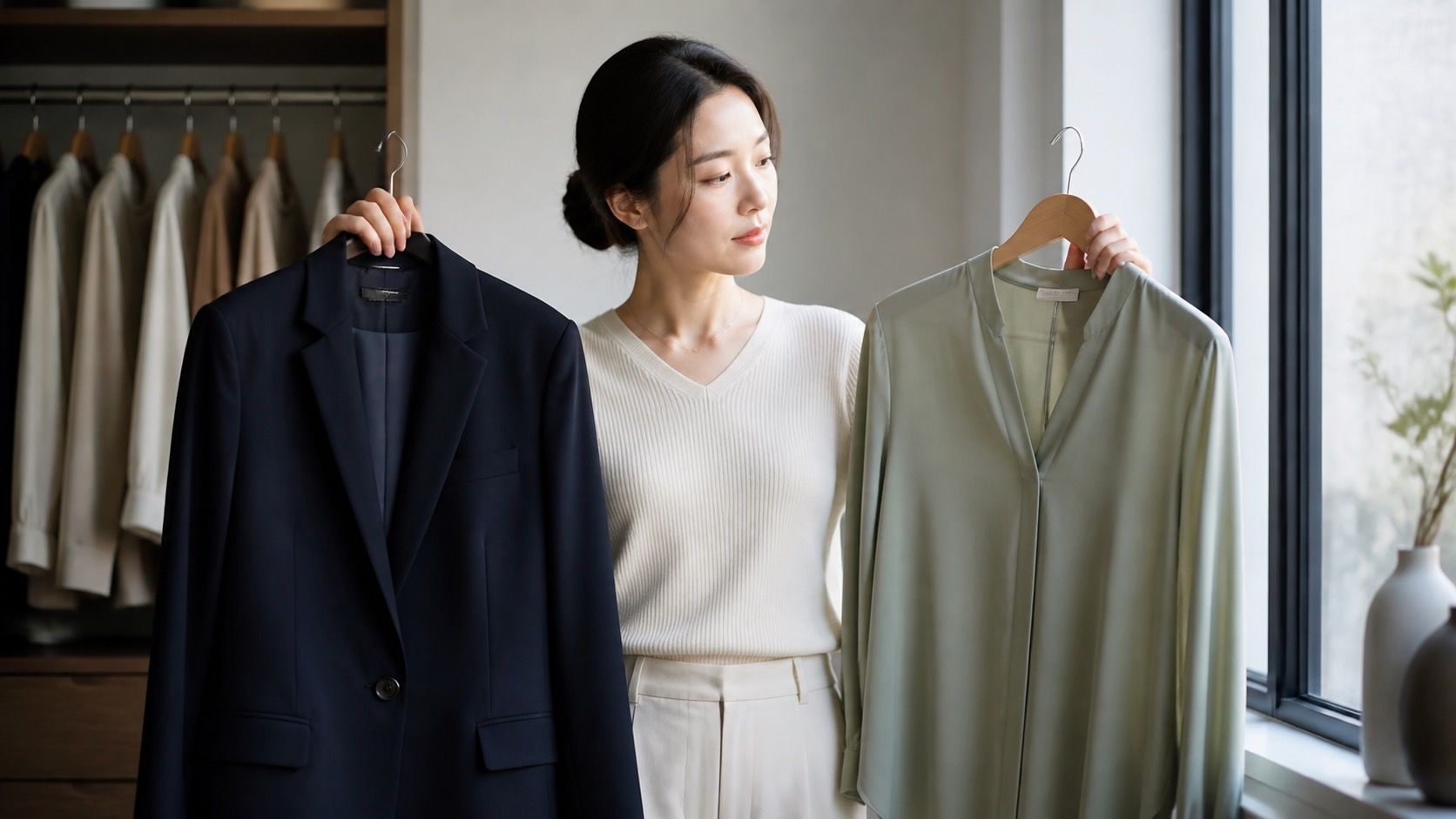
Try laying out five complete outfits on a bed. If one bright, warm item keeps breaking the picture, it is not necessarily a bad garment; it may simply need a separate role. The point is to notice friction. A pale stone blazer may work with smoky navy, mauve knitwear, and worn blue denim. A sharp camel blazer asks for a different supporting cast and can make the rest of a cool wardrobe look oddly dusty.
Choose cool neutrals before buying accent color
For this palette, soft navy, mushroom taupe, dove gray, cool beige, and soft charcoal are far more useful than a pile of pastel tops. They carry the expensive pieces: coats, trousers, bags, boots, and knitwear. Black can work, but it often creates a hard outline around an otherwise gentle face, especially in a black blazer under office lighting. Charcoal gives a similar sense of structure without that abrupt edge.
It helps to choose two main neutrals and one lighter bridge shade. For example, charcoal and faded navy can be the anchors, while cool taupe links them to lighter denim and silver jewelry. Check fabrics rather than trusting a website thumbnail. A taupe with a yellow cast will fight dusty blue; a gray-taupe that looks slightly pink or smoky tends to cooperate. Put it beside your most-worn top and decide in daylight, not under a changing-room spotlight.
| Capsule role | Reliable Soft Summer choice | Watch for |
|---|---|---|
| Tailoring | Soft charcoal or smoky navy | Inky black that overwhelms muted tops |
| Light layer | Cool taupe, dove gray, faded denim | Yellow beige or warm cream |
| Everyday shoe | Muted navy, gray, soft cocoa | Orange tan leather near bare legs |
| Bag | Dusty blue-gray or mushroom | Very glossy black hardware and leather |
Add color in softened layers
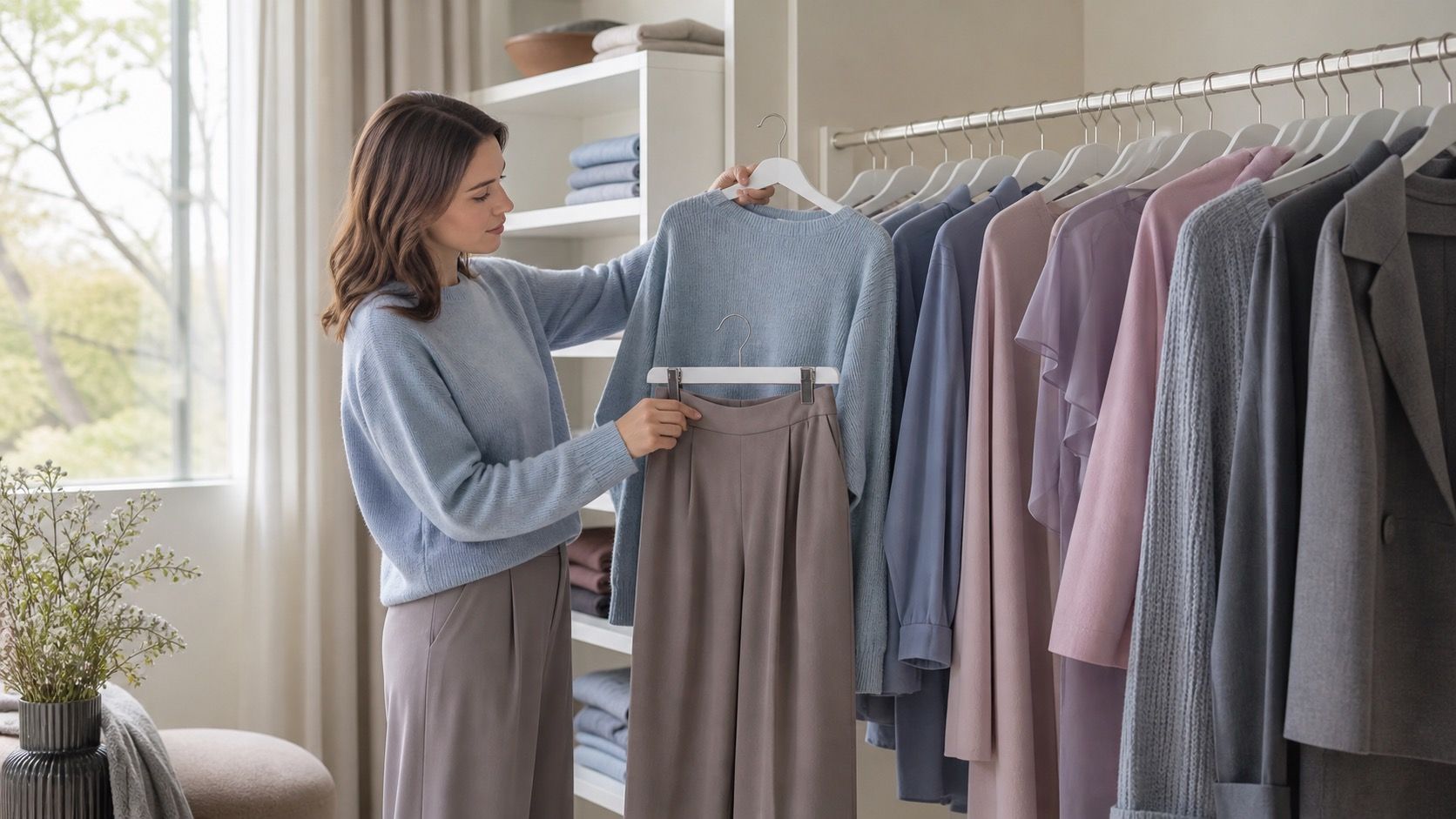
Soft Summer outfit colors are easier to use when they appear in more than one depth. Rather than collecting one lavender top, one rose skirt, and one teal scarf, choose a small family: dusty blue, muted mauve, soft plum, blue-green, and misty pink. Then a mauve T-shirt can sit under a navy overshirt, while a plum knit can work with the same gray trousers. The colors are present, but no piece has to shout.
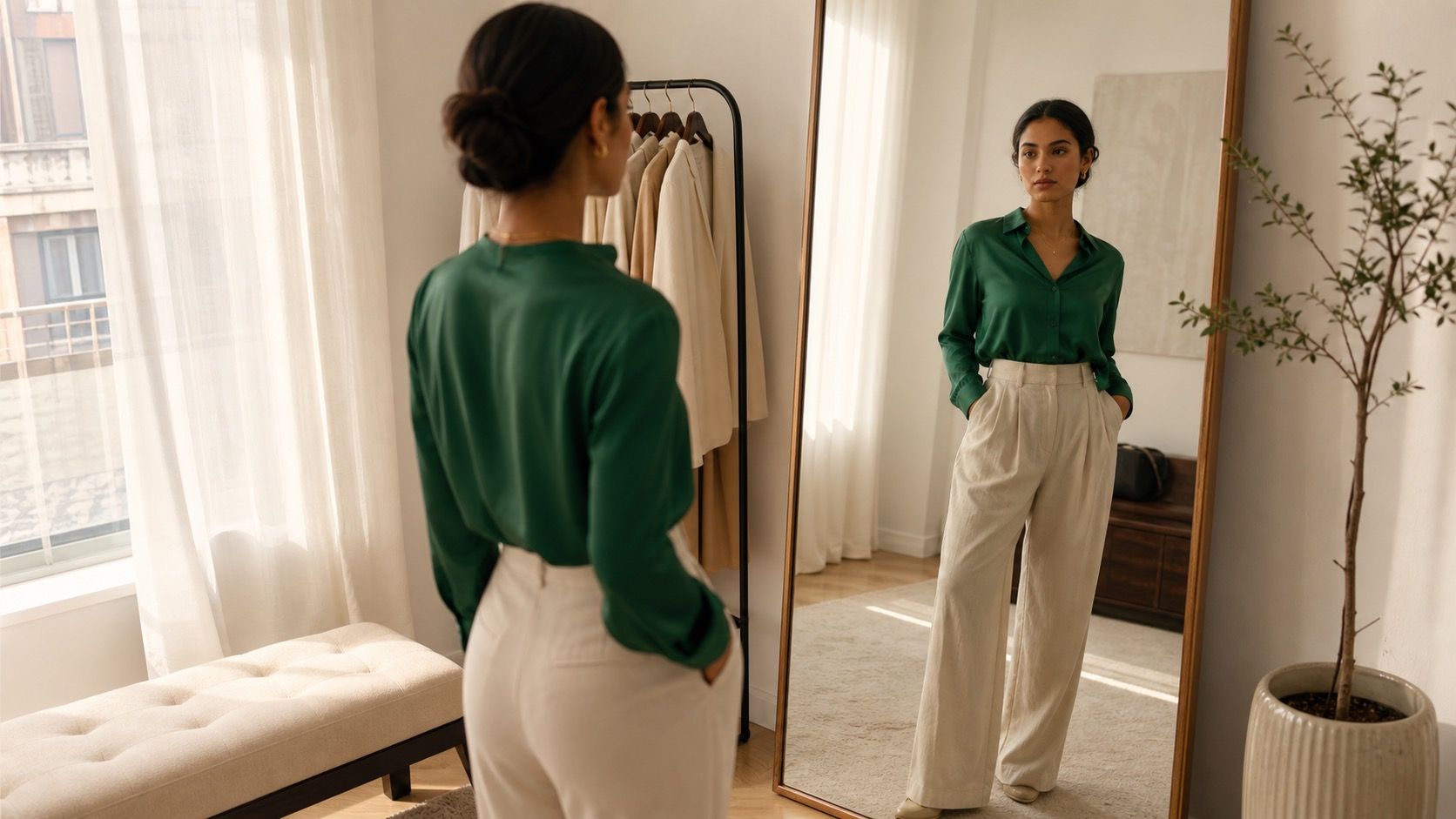
Near the face, test a color against the under-eye area and lips. A good smoky berry makes the skin look settled; a clear hot pink can arrive before you do. That does not mean bright colors are forbidden. A brighter raspberry shoe or a small earring is easy to contain because it is not framing the face. I would keep the strongest color below the waist or in a bag if the outfit already has a dark neutral at the collar.
A small list that covers a real week
A workable Soft Summer capsule can be surprisingly compact: two pairs of trousers, straight blue jeans, a soft navy skirt or relaxed dark denim, four tops, two fine knits, an overshirt or blazer, a weather layer, and shoes that do not demand a special outfit. The exact count does not matter. What matters is that the trousers talk to every top and that one layer can be thrown over each combination without creating a new color argument.
For workwear, start with charcoal trousers, a dusty blue shirt, a muted berry knit, and a cool-gray jacket. For casual days, swap the trousers for medium-wash denim and leave the shirt open over a misty rose tee. A soft navy dress can cover meetings and dinners with the same gray boots. These are not exciting formulas on paper. In practice, that is why they get worn: they save time without making you look as though you gave up.
Let denim, prints, and texture do some of the work
Denim is often the easiest bridge in a muted wardrobe, provided the wash is not aggressively warm or electric. Medium blue, faded indigo, gray-blue, and a gentle blue-black are usually more flexible than rigid dark rinse denim. Hold the jeans next to a mauve or dusty blue top. If the top suddenly looks sweeter and cooler, you have found a useful wash. If it turns dull, the denim may be too yellow or too dark.
Prints deserve the same editing. Small watercolor florals, softened checks, quiet stripes, and low-contrast abstract shapes can add movement without turning the capsule into a costume. Look for a print with at least two of your existing colors in it. Texture also creates variety when the palette stays narrow: brushed cotton, matte silk, fine merino, suede, and washed linen read differently even in related gray-blue shades. Glossy satin beside flat jersey can look more abrupt than the color itself.
Borrow outside the palette with a buffer
No wardrobe needs a border patrol. A borrowed olive utility jacket, a cream sneaker, or a red dress can still be useful if the surrounding pieces keep the overall temperature calm. The simplest buffer is distance from the face: wear warmer shoes with cool denim and a smoky top, or place a warmer belt against charcoal rather than pale gray. Makeup and jewelry can help too. Silver, pewter, and soft pearl usually make an in-between color feel less isolated.
Hair changes and a summer tan can also shift the balance a little. Instead of replacing everything, revisit the few items that sit closest to your face: a jacket, scarf, lipstick, and knitwear. If an old soft pink suddenly feels weak, try a deeper muted berry before deciding your whole palette has changed. A capsule is successful when it leaves room for that kind of adjustment. It should reduce decisions, not turn getting dressed into an exam.